

.png)

References
The mission of Team ILCS is to inform and assist the ILCS community, both in Canada and worldwide. Here, we will provide longer format articles on topics of interest and links to useful references we hope will help you all succeed. We welcome your inputs.
01
Why We Like ILCS
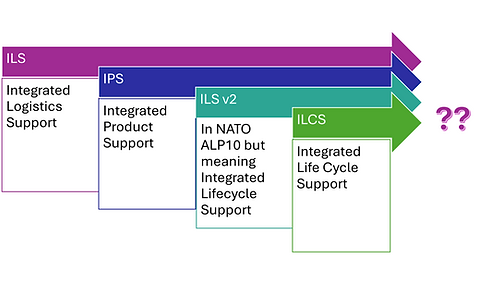
This article provides some background on the Team ILCS decision to adopt ILCS as an acronym for our thoughts on the discipline and concepts that we (supportability engineers, support providers and support managers) use to ensure complex equipment systems are (1) designed with consideration of support; and (2) sustained by an optimized and tailored support system throughout their full life cycle.
This life cycle support spans from initial needs/concepts through design and build stages, to then the lengthy in-service use and support stage and eventually to the retirement/disposal stage for the equipment and its support.
02
Lateral Thinking in Defense Parts Inventories
Another in our series of ideas and topics for discussion within the Life Cycle Support community… this time looking at an idea (and, in fact in our experience, an often-used fix) to improve repair parts supply and reduce downtime.
This graphic depicts the traditional hub & spoke military supply chain model and adds the idea of lateral flows (often called lateral transshipments or inventory pooling) for spare parts between local units, for discussion.


03
Maintenance Task Times
Effective maintenance of military equipment is central to force readiness, operational availability, and life‑cycle cost control. Defense organizations rely on structured time‑based metrics to understand how long maintenance should take, how long it actually takes, and how long equipment remains unavailable to the warfighter. Three complementary measures—Standard Repair Time (SRT), Active Maintenance Time (AMT), and Turn‑Around Time (TAT)—can provide a comprehensive view of maintenance performance across planning, execution, and operational impact.
04
Digital Ecosystem for Engineering
Recently, there has been a lot of discussion about sharing data across the various primary engineering communities of practice (COPs), and the software tools used by them. This paper provides our perceptions of some of the various digital COP domains and the typical software tools they use. It also offers some thoughts on the subset of shared data used to synchronize across these life cycle engineering COPs.


05
Thinking About Support Solutions
A common-but-inconsistent term for what it is that we ILS/IPS (or ILCS as we prefer) practitioners design, build and run is an optimized support solution for a product subset in use by a particular customer. But what is this thing we call a support solution? The term is widely used by practitioners and mentioned often in our standards and specifications, but often not defined. Pictured is our concept for a SUPPORT SOLUTION, that includes supportable ASSETS (customer equipment fleets), a range of support SERVICES, and the support RESOURCES they need, all enabled/defined by CONTRACTS/ARRANGEMENTS with support providers… what do you think?
06
Thoughts on Improving DND Maintenance Data
While such use of AI for maintenance improvement has delivered success in industry, the reporting cultures and habits of military maintainers present a particular challenge. In this article, I’ll offer some of my own thoughts on how we might better use AI to help itself become a better tool for continuous improvement of equipment maintenance and its associated support solution. These are based on my experiences and will focus on the significant challenge in applying AI to improve maintenance that is facing defense departments, specifically the Canadian Department of National Defence (DND).
